
The Budget emphasises on capacity building and empowerment of marginalised sections of society including farmers.

CII has also called for tax incentives for new health care projects and import duty relief for lifesaving equipment.

'Interim Budget has ignited the entrepreneurial spirit.'

The welfare schemes of the government, particularly Lakshmir Bhandar, have had a major impact on the electoral outcome.

Asserting that the world does not have much time to correct the mistakes of the last century, Prime Minister Narendra Modi on Friday announced a 'Green Credit Initiative' focused on creating carbon sinks through people's participation and also proposed to host the United Nations climate conference in 2028, or COP33, in India.

The government has approved the 'Terms of Reference' for the 16 Finance Commission, which makes recommendations on sharing of tax revenues between the Centre and states. The recommendations would cover a five-year period commencing April 1, 2026, Information and Broadcasting Minister Anurag Thakur said on Wednesday, giving details about the decisions taken at the Cabinet meeting last evening. The commission would submit its report by October 31, 2025, Thakur said.

But it is disappointing to note that Sitharaman's third Union Budget continues to promote a few problematic ideas, observes A K Bhattacharya.

Paris has been working on cleaning up the Seine so that people can swim in it again, as was the case during the 1900 Paris Olympics. But a sewer problem last summer led to the cancellation of a pre-Olympics swimming event.

The government plans to borrow a record Rs 15.4 lakh crore from dated securities in FY24 to meet its expenditure requirement to prop up the economy.

The number of centrally sponsored schemes have increased to 35 in FY22 from 30 in FY21 and central sector schemes have increased to 704 from 685 in the previous year, reports Dilasha Seth.

'Your decisions should not be driven by your view on the market, but by your objectives, risk appetite, and time horizon.'

ITC stock slipped over 4 per cent on Thursday (February 8) after British American Tobacco (BAT) said it could sell some of its stake in the company, recovering partially in trade. The stock of the cigarette-to-hotels conglomerate traded at Rs 420 levels, rising 1.3 per cent in intraday deals as compared to the S&P BSE Sensex that traded flat for most part of the day. The development, meanwhile, saw Jefferies downgrade the stock to 'hold' from 'buy' earlier with a target price of Rs 430, down a huge 17.3 per cent from its earlier price target of Rs 520.

'It is a balanced and prudent Budget that sets the foundation for future growth in the economy.'

'We expect the bull-market phase to still persist, but now led by large-caps which offer better valuation and benefit from FII inflows.'
'We expect continued pressure on midcaps, but any sharp correction looks unlikely from here on.'

The measures, rubber-stamped by the FIA's World Motor Sport Council by an online vote, aim to create a more level playing field for the 10 teams and a more sustainable future.

'The prime minister's comment on 'revdi culture' was welcome. But I am disappointed he did not follow up on that.' 'All political parties, including the BJP, have been guilty of this.' 'Now, Modi's guarantees, the Congress's 'nyay' path and both ruling and Opposition parties are vying with each other for freebies in my home state Andhra Pradesh.'
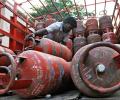
Prime Minister Narendra Modi on Friday announced a Rs 100 per cylinder cut in cooking gas LPG price to ease financial burden on households. Non-subsidised cooking gas price will be cut to Rs 803 per 14.2-kg cylinder in the national capital with effect from midnight of Friday/Saturday, official sources said. Prices vary from state to state depending on the incidence on local taxes.

Global financial firm J P Morgan has said that it plans to include Indian government bonds (IGBs) or government securities (G-Secs) into its benchmark Emerging Market index from next year, a move that will bring down borrowing cost for the government. The inclusion of the IGBs will be staggered over a 10-month period from June 28, 2024 to March 31, 2025, indicating one per cent increment on its index weight. "India's weight is expected to reach the maximum weight threshold of 10 per cent in the GBI-EM Global Diversified, and approximately 8.7 per cent in the GBI-EM Global index," J P Morgan said in a statement on Friday.

The allocation for health ministry for 2017-18 is Rs 47,352.51 crore in comparison to allocation in 2016-17 of Rs 37,061.55 crore.

The FM also proposed that the maximum deposit limit for Monthly Income Account Scheme will be enhanced from Rs 4.5 lakh to Rs 9 lakh for a single account and from Rs 9 lakh to Rs 15 lakh for a joint account.

The central government's fiscal deficit touched 67.8 per cent of the full-year target at the end of January due to higher expenses and lower revenue realisations, according to official data released on Tuesday. In actual terms, the fiscal deficit or gap between the expenditure and revenue collection during April-January period stood at Rs 11.9 lakh crore, as per the data from the Controller General of Accounts (CGA). The fiscal deficit in the comparable period of 2021-22 was 58.9 per cent of that year's Revised Estimate (RE) in the Budget.

'Most young taxpayers prefer income tax filing to be flexible yet straightforward.'

In the Union budget, Rs 65,011.8 crore has been allocated to the Ministry of Health and Family Welfare, up from Rs 62,659.12 crore in 2019-20.
GDP growth of 7.7 per cent in the first half of this fiscal has "left sceptics gasping and woefully behind the curve", an RBI article said on Wednesday. It also stressed the buildup in the growth momentum is likely to be sustained. The article on the state of the economy published in the Reserve Bank's December Bulletin on Wednesday also said CPI-based retail inflation is expected to ease to 4.6 per cent in the first three quarters of 2024-25 from 5.6 per cent in November.
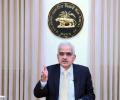
The challenge for the RBI in 2024 is likely to be less about containing elevated inflation and more about curbing excessive financial market exuberance and a 'problem of plenty', notes Sajjid Chinoy, Chief India Economist JP Morgan.

A piece of slightly negative news can cause a serious setback, warns Debashis Basu.

Chief Economic Advisor V Anantha Nageswaran on Thursday said the economy is expected to grow at 6.5 per cent in the current fiscal notwithstanding deficient rains in August. India recorded economic growth of 7.8 per cent in the April-June quarter of 2023-24 against 13.1 per cent in the year-ago period. India's economy in Q1 grew at the fastest pace in a year, on the shoulders of a boost in capital expenditure both at central and state levels, along with stronger consumption demand, especially in rural areas, and improved performance in the services sector, he said.

The government also proposed promoting 'one product one district' for better marketing and export of horticulture crops. It also called on states for early implementation of three key central model laws on land leasing, agriculture produce and livestock marketing and contract farming.

'The focus needs to shift towards the ability to collect payments, particularly in tier-3 to tier-4 areas where acceptance is still lacking.'

India also went on an overdrive in expanding its military engagement with like-minded countries in its neighbourhood and beyond in the face of China's relentless attempts to become a regional hegemon and establish its primacy in South Asia.

Moody's Investors Service on Wednesday affirmed the ratings of two major Indian IT services companies, Tata Consultancy Services Limited (TCS) and Infosys. In two separate statements, Moody's also retained stable outlook for both the companies. Moody's expects Infosys' revenues to climb by around 13 per cent for the financial year ending March 31, 2023, but moderate to around 8 per cent in the next 2024 fiscal.

India on Friday made a strong pitch for a sovereign rating upgrade with Moody's and also questioned the parameters based on which the US-based agency accords ratings, sources said on Friday. Ahead of its annual review of the sovereign rating, Moody's Investors Service representatives met Indian government officials during which the officials highlighted the reforms and strong fundamentals of the Indian economy. A higher rating for India would mean the nation is less riskier, translating into lower interest rates on borrowings.

While the corporate sector has benefited from massive capital expenditure, leading to sky-rocketing stock prices, investors would do well to keep an eye on the macroeconomic picture and government finances, not just corporate profits, for signs of trouble, alerts Debashis Basu.

The July-September quarter results of software companies in the engineering research and development (ER&D) segment were broadly in line with expectations, though there have been cuts in revenue growth guidance. While results were a mixed bag, and there are cautionary views on the near-term outlook, brokerages and global consulting firms highlight the strong growth trajectory for the sector. They expect this segment of the software sector to grow by 8-12 per cent going forward.

'We plan to add over 100,000 square kilometres every year, to reach an ambitious target of 500,000 square kilometres by 2025.'

'ISRO's style is a terrific example of being able to survive, acknowledge failures, and then most importantly of all, learn from them to ensure that subsequent missions are successful.'

Domestic commercial vehicle sales volume is expected to grow 9-11 per cent in FY24 driven by medium and heavy commercial vehicles and an estimated economic growth of around 6 per cent, rating agency CRISIL said on Monday. Besides, an increased allocation to infrastructure spending in the Union Budget for next fiscal year will support demand, it said. This would be the third consecutive year of growth in the domestic CV industry, according to CRISIL.

'The finance ministry's decision to accept the deficit target of 4.5 per cent in 2025-2026 appears to have emanated from its endorsement of the Finance Commission's view that the Indian economy will continue to remain impacted by the pandemic, adversely undermining its growth potential,' notes A K Bhattacharya.

After bumbling for years since 2014, the Modi government seems to believe that massive government expenditure will lead us to prosperity supported by 'seat-of-the-pants' decision-making, observes Debashis Basu.

The richest one per cent in India now own more than 40 per cent of the country's total wealth, while the bottom half of the population together share just 3 per cent of wealth, a new study showed on Monday.
 © 2026 Rediff.com - Advertise with us - Disclaimer - Privacy Policy - Sitemap - Feedback - About us - Terms of use - Grievances